
On January 5, 2025, in the grand ballroom of The Beverly Hilton in Los Angeles, Zoe Saldaña walked to the podium to collect her first Golden Globe Award. She has competed against Selena Gomez, Ariana Grande, Margaret Qualley, and Felicity Jones. She won for her performance in Emilia Pérez, a Spanish-language musical thriller that had already become one of the most discussed films of the year.
As the music began edging her off the stage, Saldaña rushed through one final sentence: “My family, my mom is here, my husband and my sons — I love you, you guys are everything.”
Her mother had not arrived at the Beverly Hilton as a celebrity. She arrived as she has always arrived at every major moment in her daughter’s life — as the woman who made the moment possible in the first place.
Her name is Asalia Nazario. Most of the world learned it that night.
Quick Bio
| Category | Detail |
| Full Name | Asalia Nazario |
| Heritage | Half Puerto Rican, half Dominican |
| Cultural Identity | Afro-Latina |
| Birthplace | Puerto Rico |
| Moved to USA | Around age 10, settling in Jackson Heights, Queens, New York City |
| First Husband | Aridio Saldaña (Dominican) — died in car accident, 1987 |
| Second Husband | Dagoberto Galán (Dominican) |
| Daughters | Mariel Saldaña, Zoe Saldaña (born June 19, 1978, Passaic, NJ), Cisely Saldaña |
| Grandchildren | Eli and Kasey (Mariel’s children); Cy Aridio, Bowie Ezio, and Zen (Zoe’s sons) |
| Jobs Held | Courtroom translator, hotel maid, seamstress |
| Languages | Spanish and English (bilingual) |
| Current Life | Private; resides near family; occasional public appearances at major events |
| Most Recent Public Appearance | 2025 Golden Globe Awards red carpet with Zoe |
Puerto Rico: Where the Story Begins
Asalia Nazario was born in Puerto Rico, the Caribbean island that sits at the intersection of Spanish colonial history, African diaspora culture, and American political circumstance. Puerto Rico is not simply a geographic location — it is a cultural identity, a particular way of understanding family, community, language, and belonging that its people carry with them across any distance they travel.
Asalia’s background carries a specific blend. Her mother was from Puerto Rico and her father from the Dominican Republic, making her half Puerto Rican and half Dominican — a combination that placed her at the heart of two of the Caribbean’s most vibrant cultural identities from birth. She is Afro-Latina, a designation she has embraced as a core part of who she is and one she ensured her daughters understood and felt proud of from an early age.
She was approximately ten years old when she left Puerto Rico and moved to the United States with her mother. They settled in Jackson Heights, Queens — a neighborhood in New York City that has been home to successive waves of Caribbean, Latin American, and South Asian immigrants, a place where multiple languages fill the air on a single street corner and where belonging is something you build rather than something automatically given.
Arriving in New York at ten years old, in a new country, speaking Spanish as her first language, absorbing English as a necessity — those early years in Queens gave Asalia possesses both the unique hardiness that comes with navigating a world that was not designed with you in mind and the bilingual skill that would later prove to be a lifeline for her family.
See also “John Jannsen: The Insurance Guy Who Somehow Became Reality TV’s Most Talked-About Boyfriend“
Aridio Saldaña: Love, Family, and the Life They Built Together
In New York City, Asalia met Aridio Saldaña. He was a Dominican man, and the connection between them was built on shared values, shared cultural roots, and a shared vision of the kind of family they wanted to create. They married and made their home together in Queens.
Together they had three daughters. Mariel arrived first. Zoe Yadira Saldaña Nazario was born on June 19, 1978, in Passaic, New Jersey. Cisely followed. Three girls, raised bilingual in Spanish and English — Spanish was the first language of the household, English the language of the world they were growing up in.
The family they built was a genuinely bicultural one. Aridio’s Dominican heritage and Asalia’s Puerto Rican-Dominican roots created a household where both Caribbean traditions lived side by side, where the food, the music, the language, and the family values that came from both islands shaped three young girls simultaneously. Zoe has said in multiple interviews across her career that this cultural layering — understanding herself as Dominican and Puerto Rican, as Afro-Latina, as a product of a specific Caribbean confluence — was not something she had to discover or claim later in life. It was given to her at the dinner table, in the way her mother spoke, in the stories her parents told.
Aridio was a man his daughters adored. Zoe has described him in interviews as someone who was possessive of his daughters in the loving, protective way of fathers who cannot quite believe their good fortune. She remembers his laugh specifically — loud, open-mouthed, uncontainable — and has noted that her own laugh, and her sisters’, belongs to him. He walked on water in his daughters’ eyes.
1987: The Year That Changed Everything
In 1987, Aridio Saldaña was killed in a car accident. Zoe was nine years old.
What happened to Asalia Nazario in that moment is not something that can be described with clinical accuracy. Zoe has spoken about it in multiple interviews across the years, and what emerges is a picture of complete devastation. Her mother, by Zoe’s account, could not get out of bed. She could not take her daughters to school. The person who had been the anchor of daily life was, for a period, simply unable to function. Grief has done what grief does when it arrives without warning and takes the center of everything.
Zoe recalled hearing of her father’s death from her grandmother, who was drinking coffee and said simply:”rt of life: death came knocking and took one of us.”
For Asalia, no grandmother delivered those words. She was the one who had to find them for herself.
And she did. Not quickly. Not without cost. But she found them.
The Decision That Required More Courage Than Any Career Choice
After Aridio’s death, Asalia faced a problem that was simultaneously practical and heartbreaking. She was a widow in New York City in the late 1980s, with three young daughters, limited financial resources, and the knowledge that the city she lived in was not, at that time in its history, a secure setting for young girls growing up fatherless.
She made a decision that only a person who loved her children more than she loved her own comfort could make. She sent Mariel, Zoe, and Cisely to the Dominican Republic to live with their late father’s family. She stayed behind in New York.
The distance was enormous. The separation was painful in ways that do not become less painful simply because they were chosen deliberately. These were her daughters. They had just lost their father. And now they were losing daily proximity to their mother too — not because Asalia did not want them near her, but because she was doing what the situation required.
What Asalia required of herself during those years was extraordinary. She worked two jobs simultaneously. She began working as a maid in a hotel. She used her bilingual fluency in Spanish and English to work as a courtroom translator — a role that demands precision, composure, and the ability to render complex legal language accurately in real time across two languages. She did both jobs, across the irregular schedules of a New York City life, sending money to the Dominican Republic so that her daughters could attend private school.
She stayed defeated, by Zoe’s account, for years — the defeat visible in her face even as she kept moving. But she kept moving. She put one foot in front of the other, as Zoe described it years later, even when the feet did not want to cooperate.
The Dominican Republic Years: Where Zoe Became Herself
While Asalia worked in New York, her daughters were growing up in the Dominican Republic in the care of their father’s family. For Zoe, those years became foundational in ways that neither she nor her mother could have entirely predicted.
She discovered ballet during those Dominican years. The dance classes that began as a practical activity during a difficult childhood transition became the technical foundation of a performing career. Her first major film role — in Center Stage in 2000 — required her to play a ballet dancer. The ability that got her in the door came from classes taken in the Dominican Republic during the years after her father died.
The family also watched films together during this period. Science fiction specifically. Zoe has mentioned watching Star Trek and 2001: A Space Odyssey during those years, and the love for that genre — the genre that would eventually make her one of the highest-grossing film actresses in history through Avatar and the Guardians of the Galaxy franchise — was seeded in those family viewing sessions.
Asalia, working her two jobs in New York, was simultaneously building the financial foundation that made those private school years possible and staying tethered to her daughters across hundreds of miles. The mother who could not get out of bed in 1987 had become, by necessity and will, the sole economic engine of a family distributed across an ocean.
The Return to New York: Political Unrest and a Teenager at Newtown High
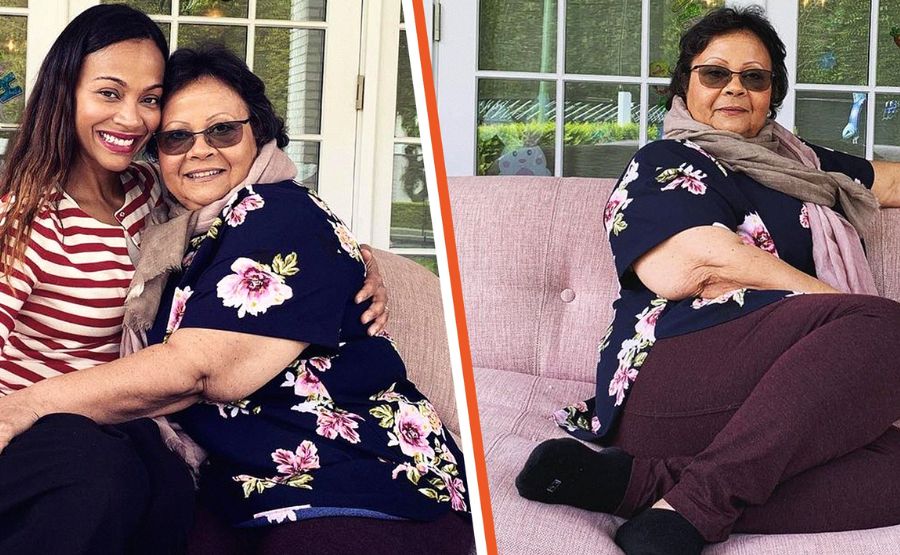
The family’s time in the Dominican Republic was not permanent. When political unrest made the situation there unstable, Asalia made the decision to bring the family back to the United States. Zoe was in her sophomore year of high school when the move occurred.
She completed her early education at Newtown High School in Queens — the same Queens borough where she had spent her early childhood in Jackson Heights. The family resettled, the girls resumed life in New York, and Zoe began the process of building what would become one of the most extraordinary film careers of her generation.
That return to New York was made possible by years of Asalia’s disciplined labor. She had not simply survived the years of separation — she had converted them into financial stability, into private school education, into a household the family could return to. The sacrifice was not abstract. It produced measurable outcomes in her daughters’ lives.
Dagoberto Galán: A New Chapter, Carefully Written
After years of grief and labor, Asalia Nazario fell in love again. She married Dagoberto Galán, a Dominican man who entered her life and her daughters’ lives and took the role of stepfather with a seriousness and warmth that earned him a different designation entirely.
Zoe has been publicly clear about this. She does not call Dagoberto her stepfather. She calls him her dad. “Since day one, that’s what he’s been to us — our kind of crazy beauty,” she told The Huffington Post. He goes to important family gatherings. He has been present at ceremonies and celebrations. He is, by all accounts from the daughters themselves, the kind of person who showed up and kept showing up, which is the only thing that ultimately distinguishes a stepfather from a father.
Asalia’s ability to allow that relationship to develop — to rebuild not just her own life but the emotional architecture of her daughters’ family — reflects something about who she is that the details of her working years do not fully capture. She had lost her husband. She had sent her children away. She had worked two jobs for years. And she had come through all of it with enough of herself intact to love again, and to give her daughters a father figure they could trust.
The Daughters She Raised: What She Built
Mariel, Zoe, and Cisely Saldaña grew up to be three women who took the foundation their mother built and extended it into the world in ways that honor it.
Zoe’s film career has made her one of the most commercially successful actresses in the history of cinema. Her films — Avatar, Avatar: The Way of Water, Avengers: Infinity War, Avengers: Endgame, Guardians of the Galaxy — have collectively generated over $13 billion globally. For her performance in Emilia Pérez, she received both an Academy Award and a Golden Globe for Best Supporting Actress. She is the second-highest-grossing film actress of all time.
She is also the mother of three sons with her husband Marco Perego: twins Cy Aridio and Bowie Ezio, born November 2014, and Zen. The twins’ middle names — Cy Aridio and Bowie Ezio — honor both of their grandfathers. Cy’s middle name is Aridio, for the grandfather these boys will never meet but whose name they carry. That choice came from Zoe. It also came, in its deepest logic, from Asalia — the woman who made sure her daughters never forgot their father, even while building a life that did not require them to stop at his memory.
Mariel has two children of her own. Cisely, alongside Zoe and Mariel, co-founded Cinestar Pictures, a production company explicitly focused on telling women’s stories. That company — built by three sisters who watched their mother do everything alone for years — is, among other things, a tribute to Asalia Nazario expressed in professional form.
On the Red Carpet, Arm in Arm
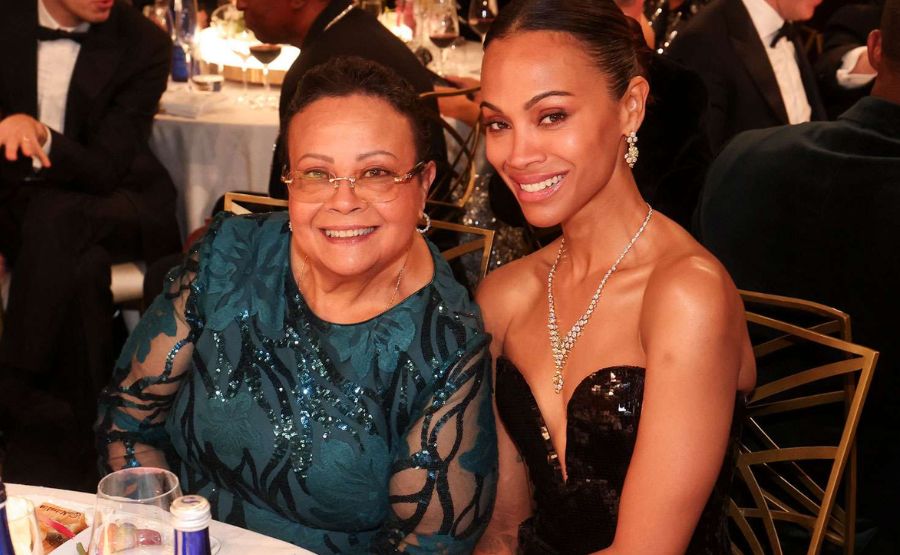
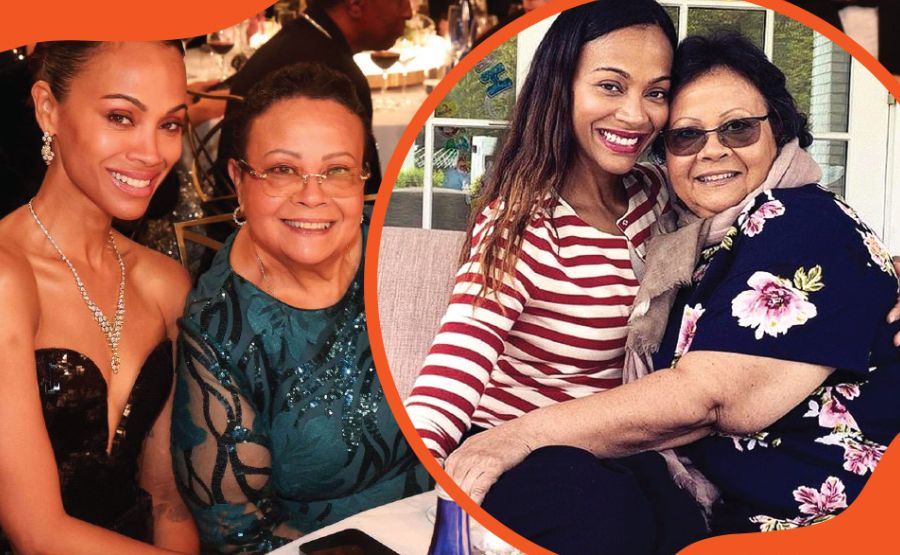
On January 5, 2025, Asalia Nazario stepped onto the Golden Globes red carpet at the Beverly Hilton in Los Angeles wearing a blue lace ensemble. Beside her, arm in arm, was Zoe — dressed in a shimmering brown gown, wearing her first Golden Globe nomination the way a person wears the culmination of decades of work.
Photographs from that evening show the two of them facing photographers together. Asalia does not shrink from the cameras, but she does not perform for them either.She stands the way someone does when they feel like they belong, not because they own the space but rather because the person next to them does.
When Zoe won the award that evening — beating Selena Gomez, Ariana Grande, Margaret Qualley, Felicity Jones, and Isabella Rossellini — she said her mother’s name from the podium. She said “my mom is here” with the emphasis of someone for whom the statement carries specific weight.
Later that same awards season, at the 2025 Academy Awards, Zoe Saldaña won Best Supporting Actress for the same role — only the third Latina in Oscar history to win in that category. In her acceptance speech, she said: “To my mom, my dad and my sisters — everything brave, outrageous and good that I’ve ever done in my life is because of you.”
Everything brave, outrageous and good.
That sentence belongs to Asalia Nazario as much as it belongs to Zoe.
Who Asalia Nazario Is, Outside the Famous Daughter
Strip away the awards season appearances, the red carpet photographs, and the context of Zoe’s career, and what remains is a woman who has always preferred to be understood in private.
Asalia has no active public social media presence. She does not give interviews. She does not maintain a personal brand or a platform. She is bilingual, elegant by the accounts of people who have observed her at events, and possessed of what her daughters describe as a kind of innate dignity — the dignity of someone who has been through a great deal and has chosen not to perform either the suffering or the survival.
She is a grandmother. Zoe’s twins call their middle names after their grandfathers. The family gathers. The family celebrates. Asalia Nazario is present at the center of all of it, which is where she has always been.
What the Online Record Gets Wrong
A significant number of websites have published entirely fabricated information about Asalia Nazario.According to several accounts, she was born in 1990, making her younger than her own daughter Zoe, who was born in 1978. One article places her birth in “a small town” without specifying where, calls her an “artist,” and discusses her “career in the arts” without any factual basis. Another assigns her a birth date of October 15, 1990, and an invented biography about moving to the United States to study Fine Arts after high school.
None of this is accurate. The verified record is clear: Asalia Nazario was born in Puerto Rico, is of Puerto Rican and Dominican heritage, moved to New York City around age ten, married Aridio Saldaña had three daughters, lost her husband in 1987, worked as a hotel maid and courtroom interpreter, sent her girls to a private school in the Dominican Republic, later remarried Dagoberto Galán, and raised three ladies who went on to lead fulfilling lives and careers.
The fabricated version is not only false. It is an insult to a real person’s real story — a story that is far more interesting and far more worth telling than anything a content generator could invent.
Final Words
Asalia Nazario is a Puerto Rican-Dominican woman who moved to New York at ten years old, fell in love, built a family, lost her husband to a sudden accident when her daughters were still children, sent those daughters across an ocean so they could have opportunities she could not otherwise give them, worked two jobs alone in a city that was not especially gentle to single mothers in the late 1980s, rebuilt herself slowly over years, remarried and gave her daughters a father figure they still call Dad, and lived to walk onto the Golden Globe red carpet arm in arm with the daughter who won.
She has never given a press conference about any of this. She has never written a memoir. She has never leveraged a daughter’s fame into a personal platform.
She simply lived it. Quietly, consistently, and with a kind of courage that does not announce itself because it does not need to.
Zoe Saldaña’s Oscar acceptance speech said it most directly: everything brave, outrageous and good came from somewhere. It came from a woman in Queens who worked two jobs so her daughters could attend private school in the Dominican Republic. It came from a woman who chose to keep going even when she could not get out of bed.
It came from Asalia Nazario.
FAQs
1. Who is Asalia Nazario?
She is the widow of Aridio Saldaña and the mother of actress Zoe. She was born in Puerto Rico and is of mixed Puerto Rican and Dominican heritage. She is widely recognized for her resilience as a single mother following her first husband’s death in 1987, and for her foundational influence on her three daughters’ lives and values.
2. Where was Asalia Nazario born?
In Puerto Rico. She moved to the United States around age ten, settling with her mother in Jackson Heights, Queens, in New York City.
3. What is Asalia Nazario’s ethnic background?
She is Afro-Latina — specifically half Puerto Rican and half Dominican.She had a Puerto Rican mother and a Dominican father.. She married Aridio Saldaña, who was fully Dominican, creating a household that blended Puerto Rican and Dominican culture for their daughters.
4. Who was Aridio Saldaña?
Asalia’s first husband and the father of her three daughters. He was from the Dominican Republic. He died in a car accident in 1987, when Zoe was nine years old. Zoe named one of her twin sons Cy Aridio in his memory.
5. What happened after Aridio Saldaña’s death?
Asalia was devastated. By Zoe’s account, she was unable to function initially — unable to get out of bed or take her daughters to school. Over time, she recovered and made a series of difficult but strategic decisions: sending her daughters to the Dominican Republic to live with their paternal family and staying in New York to work and fund their private school education.
6. What jobs did Asalia Nazario work to support her daughters?
She worked simultaneously as a hotel maid and a courtroom translator. Her bilingual fluency in English and Spanish made the translator role possible, and she used both incomes to pay for her daughters’ private school education in the Dominican Republic.
7. Who are Asalia Nazario’s daughters?
Mariel Saldaña (the eldest), Zoe Saldaña (born June 19, 1978, in Passaic, New Jersey), and Cisely Saldaña (the youngest). All three were raised bilingual in Spanish and English.
8. Who is Dagoberto Galán?
Asalia’s second husband. He is Dominican. After marrying Asalia, he became the stepfather to her three daughters, though Zoe and her sisters do not use the word “stepfather” — they call him their dad. He accompanies the family to events and has been a consistent presence in their lives.
9. Why did Asalia send her daughters to the Dominican Republic?
She felt New York City in the late 1980s was unsafe for three young girls without their father. She also wanted them to have quality private school education, which she could fund from New York but not provided locally. The separation was painful but purposeful.
10. Was Asalia Nazario at the 2025 Golden Globes?
Yes. She walked the red carpet arm in arm with Zoe on January 5, 2025, wearing a blue lace ensemble. Zoe won Best Supporting Actress that evening for Emilia Pérez and acknowledged her mother from the podium: “My mom is here — I love you, you guys are everything.”
11. What did Zoe Saldaña say about her mother at the 2025 Academy Awards?
When accepting the Oscar for Best Supporting Actress, Zoe said: “To my mom, my dad and my sisters — everything brave, outrageous and good that I’ve ever done in myThroughout the entire awards season, it was one of the most frequently quoted lines: “Life is because of you.”
12. Is Asalia Nazario on social media?
She is not known to be active on any public social media platforms.. She maintains her privacy deliberately and does not use her daughter’s fame as a platform.
13. What production company did Asalia’s daughters start together?
Zoe, Mariel, and Cisely Saldaña co-founded Cinestar Pictures, a production company focused on telling women’s stories. Its founding reflects the values instilled by their mother — strength, female solidarity, and the importance of the stories women tell about themselves.
14. What is the most important fabrication appearing online about Asalia Nazario?
Multiple websites claim she was born in 1990, was born in “a small town,” and has a career in the arts. These are entirely invented. Asalia Nazario was born in Puerto Rico, is of Puerto Rican and Dominican heritage, and built her life as a bilingual working mother — not as an artist or public figure.
Keep discovering, connecting, and thriving with The Nexus Magazine every day.