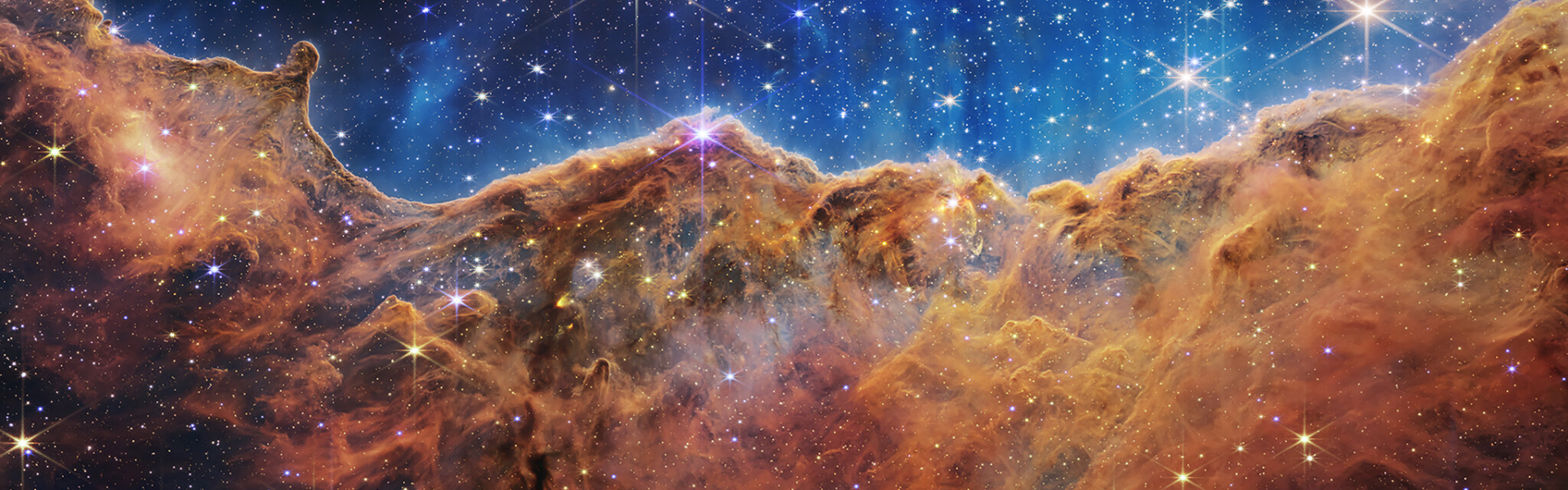

When the James Webb Space Telescope launched at the end of 2021, astronomers expected it to be powerful. What they did not fully anticipate was how thoroughly it would overturn their assumptions. Positioned roughly a million miles from Earth and equipped with a mirror six and a half meters across, Webb sees the universe in infrared light, which lets it peer through cosmic dust and, crucially, look back across almost the entire history of the universe. In the years since it began work, it has done something rarer than confirm what we knew. It has repeatedly shown us that we were wrong.
Looking Back to the Beginning
Because light takes time to travel, looking far into space means looking far back in time. Webb was built to capture light from the earliest galaxies, and it has pushed that boundary further than many thought possible. Astronomers measure the distance of these ancient objects using redshift, the stretching of light toward longer, redder wavelengths as it crosses an expanding universe. The higher the redshift, the older and more distant the object.
Webb has broken its own distance record more than once. The current champion, a galaxy designated MoM-z14, has a redshift of 14.44, meaning we see it as it existed just 280 million years after the Big Bang. To put that in perspective, this is light that began its journey when the universe was a tiny fraction of its present age. One study co-author admitted that while the team hoped to find very early objects, none of them expected to shatter the record.
Galaxies That Should Not Exist Yet
The bigger surprise is not simply how far away these galaxies are, but what they look like. According to NASA, MoM-z14 is brighter, more compact, and more chemically enriched than astronomers expected for such an early era. It is not alone. Webb has found a growing population of young galaxies that appear too bright, too massive, and too mature to have formed so quickly after the universe began.
This is a genuine problem for existing theory. The standard picture holds that galaxies assembled gradually, building up mass and heavy elements over long stretches of time. Yet Webb keeps finding early galaxies that seem to have skipped ahead. One team identified around 300 objects in the early universe that were simply brighter than they should be. As one astronomer put it, these galaxies look nothing like what was predicted.
The Mystery of the Little Red Dots
Among the strangest of Webb’s findings are the so-called little red dots, tiny but intensely bright objects scattered through the early universe. Their nature has puzzled researchers since they first appeared in the data. One leading explanation is that many of them harbor rapidly growing supermassive black holes at their centers.
Supporting this idea, astronomers used Webb to confirm an actively growing supermassive black hole inside a galaxy just 570 million years after the Big Bang. Finding such massive black holes so early is difficult to reconcile with our models, which struggle to explain how they could have grown so large so fast. Each of these discoveries adds a piece to a puzzle that, for now, has no complete solution.
Light Piercing the Cosmic Fog
Another finding challenged a well-established chapter of cosmic history. In the universe’s infancy, space was filled with a fog of neutral hydrogen gas that should have absorbed certain kinds of light. Yet Webb detected bright hydrogen emission, known as Lyman-alpha light, from a galaxy called JADES-GS-z13-1, seen just 330 million years after the Big Bang.
That this light reached us at all is a mystery. Something must have cleared the fog around that galaxy far earlier than expected, perhaps intense radiation from its first stars or an energetic black hole. The discovery is forcing astronomers to rethink the timeline of when and how the early universe became transparent to light.
More Than the Distant Past
Webb’s reach is not limited to the dawn of time. It has captured a chaotic merger of at least five galaxies roughly 800 million years after the Big Bang, spreading heavy elements out into the surrounding space and showing that galaxies were already shaping their environments earlier than predicted. It has identified a strong candidate for one of the earliest known spiral galaxies with a central bar, a structure like the one at the heart of our own Milky Way.
Closer to home, the telescope has turned its instruments on our own solar system, capturing bright auroral activity on Neptune for the first time. This range, from the most distant galaxies ever seen to the shimmering lights of a planet in our cosmic backyard, is a reminder of just how versatile the observatory is.
A Telescope That Keeps Asking Questions
The recurring theme of Webb’s early years is humility. Again and again, the telescope has found a universe that formed faster, shone brighter, and grew more complex in its youth than our best theories allowed. Rather than closing questions, it has opened them. That the observatory keeps breaking its own records suggests the most surprising discoveries may still lie ahead, and that our understanding of how the cosmos began is very much a work in progress.
