Jesse Cole Net Worth: The Guy in the Yellow Tux Built a $500 Million Company and Still Isn’t Rich (On Paper, Anyway)

Here’s a number that’s going to mess with your head for a second. Jesse Cole built an entertainment company worth roughly half a billion dollars. His personal net worth sits at somewhere around $4 to $6 million.
Read that again. The business is worth 100 times more than the man who owns it. That gap is the entire story.
Quick Bio
| Detail | Info |
| Full Name | Jesse Cole |
| Born | March 13, 1984 |
| Birthplace | Scituate, Massachusetts |
| Current Age | 42 |
| Education | Wofford College, graduated 2006 |
| Occupation | Savannah Bananas & Banana Ball founder and owner of Fans First Entertainment |
| Spouse | Emily McDonald Cole |
| Children | One biological son (Maverick), two adopted daughters |
| Residence | Belmont, North Carolina |
| Signature Look | Yellow tuxedo |
| Personal Net Worth | Estimated $4–6 million |
| Company Valuation (Fans First Entertainment) | Approximately $500 million (per Forbes, 2025) |
| 2025 Company Revenue | Over $100 million |
| Books Authored | “Find Your Yellow Tux” (2017), “Fans First” (2022), “Banana Ball” with Don Yaeger (2023) |
Already you can see the contradiction sitting right there in the numbers. Let’s dig into how that actually happened.
A Bank Account With $268 In It
You want the real starting point of this story? Not the yellow tuxedo. Not the viral TikToks. A 23-year-old kid named Jesse Cole takes a job as general manager of a college summer baseball team in Gastonia, North Carolina, with exactly $268 sitting in the team’s bank account.
The team was the Gastonia Grizzlies. They’d gone 16 and 37 the year before. They were losing $150,000 annually. Nobody wanted that job, which is exactly why a 23-year-old with zero experience got it.
He spent ten years there. Ten years learning, by his own account, mostly through failure — how to sell tickets nobody wanted, how to convince sponsors to take a chance on a team nobody believed in.
See also “Capri Jones: He Hit 7 Million Followers Before He Could Legally Vote“
The Part Where He Almost Lost Everything
Fast forward to 2015. Jesse and his wife, Emily, decided to expand into Savannah, Georgia, buying an expansion franchise in the Coastal Plain League. They named the team after a fan suggestion during a public naming contest: the Savannah Bananas.
The announcement got them booed around town. Locals reportedly told them straight up the team would never sell a ticket. They sold a handful of tickets in the first few months. By January 2016, the account had overdrafted completely.
Here’s the part most “inspiring founder” content skips over because it’s not glamorous. Jesse and Emily sold their house. They emptied their savings account. They continued despite finding what he described as essentially the trash of a building—an old garage converted into a temporary studio.
That’s not a cute origin story footnote. That’s two people who had genuinely nothing left to lose, betting everything on a baseball team named after a joke.
How a Joke Name Became a $500 Million Business
The Bananas’ first season actually went well competitively — they won their division, took home the league’s championship trophy that year. But Jesse wasn’t satisfied with just winning baseball games. He’d been mentally chewing on something deeper: even with fans enjoying the games, attendance wasn’t where he needed it to be.
So he looked outside baseball entirely for answers. Walt Disney. P.T. Barnum. The showmen who built entire industries on spectacle rather than just product. That’s when his thinking shifted from running a sports team to running a theatrical production that happened to involve a baseball diamond.
By 2018 that thinking had a name: Banana Ball. A completely reworked version of the sport — two-hour time limit, no walks, no bunting, no stepping out of the batter’s box, no mound visits, and fans in the stands can catch a foul ball for an actual out. Every single rule designed around one obsession: never let the game get boring.
It worked. The team has sold out every single game since their first season. The waitlist for tickets has ballooned into the millions.
The Yellow Tux Isn’t Just a Costume
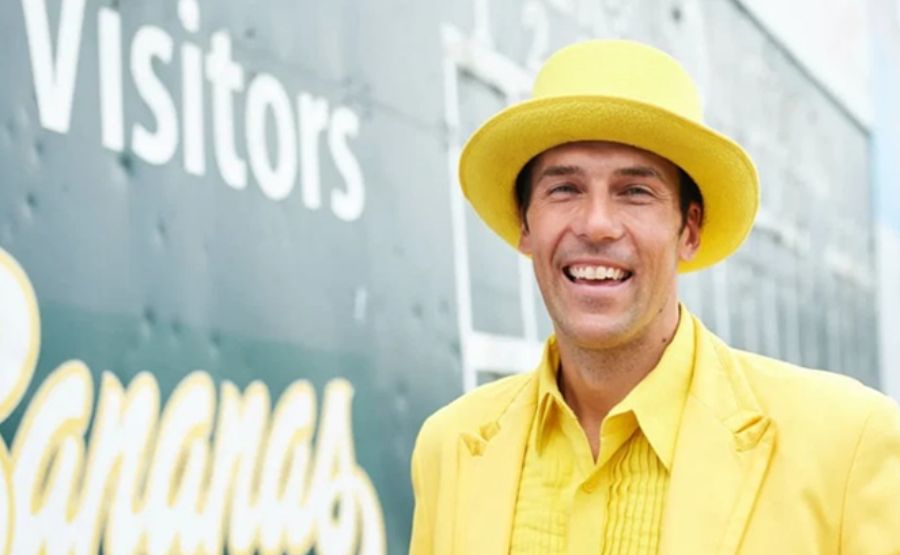
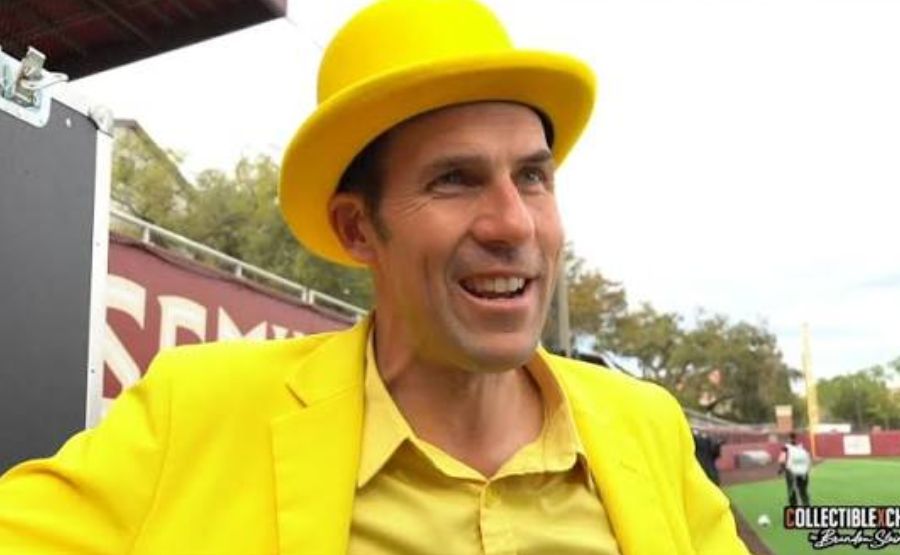
You’ve probably seen the photos even if you don’t follow baseball even a little. Jesse Cole, standing in the dugout or the stands, dressed head to toe in a bright yellow tuxedo. He even proposed to Emily wearing it.
This is branding, plain and simple, and it’s genuinely smart branding. In a sport full of guys in matching gray suits and team polos, a man in a banana-yellow tux is impossible to scroll past. You see him once, you remember him. That’s deliberate. That’s not an accident or a personality quirk — that’s a business decision wearing a costume.
Wait — How Is His Personal Net Worth So Low?
The majority of the media ignores this, which is actually the most intriguing financial aspect in his whole story. Jesse Cole could almost certainly be sitting on a much bigger personal fortune right now. He’s choosing not to.
Multiple outlets covering his finances note the same pattern: rather than extracting cash out of the business for himself, he plows profits straight back into Fans First Entertainment. New stadium experiences. Tour logistics. Players pay. Production quality. Round and round it goes back into the machine instead of into his own pocket.
That’s a real strategic choice, and it’s the opposite of how a lot of sports-team owners operate. He’s betting on long-term equity compounding rather than short-term personal liquidity. Whether you find that admirable discipline or borderline reckless depends entirely on your own relationship with risk.
The Company Itself Is a Different Story Entirely
While Jesse’s personal number stays modest, Fans First Entertainment — the company he and Emily own completely, with zero outside investors and no corporate board — was valued at roughly $500 million as of 2025, according to Forbes. In that same year, the organization pulled in more than $100 million in revenue. That’s more profit than several actual MLB franchises generate.
Some reporting has even floated buyout offers reportedly approaching $1 billion, though I want to be straight with you: that figure is far less solidly sourced than the Forbes valuation, and should be treated as speculative chatter rather than confirmed fact.
Here’s what is solid: in 2025 alone, the Bananas sold roughly 2.2 million tickets across 113 shows, averaged half a million television viewers per broadcast, and moved close to 1.9 million pieces of merchandise. For 2026, they’re targeting 190 games across 75 stadiums in 45 states, chasing over 3 million tickets sold.
That is not a baseball team anymore. That’s a national touring entertainment operation that happens to use a bat and ball.
What About the Players? This Part Actually Matters
Here’s something genuinely worth pausing on, especially if you care about fairness in sports business — which, frankly, more people should. Savannah Bananas players reportedly earn an average of around $100,000 annually across a 50-to-65 game season.
Compare that to a typical minor league baseball player, grinding through 120-plus games a year for somewhere between $20,000 and $30,000. That’s not a small gap. That’s the difference between barely scraping by and actually building a life.
Jesse Cole built something that pays entertainers — because that’s genuinely what these players are — closer to what their actual market value should be, instead of the historically brutal wages minor league baseball has been notorious for. Whatever else you think about the gimmicks and the dancing and the yellow tux, that part deserves real credit.
Not Everyone’s Buying the Hype
I’d be doing you a disservice if I only gave you the highlight reel. Plenty of serious sports writers have taken real shots at the Bananas’ touring model. One widely circulated takedown argued that once the team leaves its home stadium in Savannah and starts playing the Party Animals in some random NFL stadium hundreds of miles from Georgia, the entire “rooting for the home team” emotional core completely evaporates. You’re just watching two interchangeable groups of guys dance and do bits you’ve already seen on your phone.
That’s a fair criticism, honestly. A lot of the appeal genuinely does live online first, in short clips, and the live show risks becoming a slightly worse version of something you already watched for free that morning.
On the flip side, plenty of others argue the exact opposite — that MLB itself, with its three-hour-plus games and lopsided blowout scores, has way more to learn from Banana Ball’s pacing obsession than the other way around. Both takes have real merit. Because the revenue figures are high, I won’t claim that this is an unquestionably successful firm.
Family, and the Stuff That Actually Grounds Him
Jesse and Emily have three kids together — a biological son named Maverick, and two adopted daughters. They live in Belmont, North Carolina, away from the Savannah spotlight, which honestly tracks with everything else about how deliberately this guy manages his public-versus-private boundaries.
There’s a quieter, heavier thread running through his story too. In 2013, his father was diagnosed with two separate forms of cancer simultaneously — non-Hodgkin’s lymphoma and colon cancer — and underwent aggressive treatment at Beth Israel Hospital in Boston while Jesse was hundreds of miles away running the Gastonia operation. He’s talked about how much his father’s approach to life shaped his own values, baseball and otherwise.
That’s the part nobody puts in the highlight reel, and honestly, it’s the part that probably matters most in understanding why he is who he is.
So Is the Whole “Modest Net Worth” Thing Genuine, Or Just Good PR?
Let’s be honest about this for a second, because I think it’s a fair question to ask of literally anyone whose financials get this much public scrutiny. Is the relatively modest $4-6 million personal figure a real, humble reinvestment strategy — or is it a number that conveniently plays well with the “fans first, not me first” brand he’s built his entire empire around?
I think the honest answer is: probably both, and that’s not actually a contradiction. Good branding usually works precisely because it’s not fake. The reinvestment strategy is real — you can see it in the stadium upgrades, the production budgets, the player pay increases. But it’s also undeniably convenient that “the guy who built a $500 million company stays humble” makes for a better story than “the guy who built a $500 million company bought three yachts.” Both things can be true at once.
Final Thoughts
I’ll level with you. I came into this expecting another tired “secret millionaire” net-worth-bait article, and what I actually found was a genuinely unusual business story.
Jesse Cole didn’t get lucky. He spent a literal decade losing in Gastonia before he ever touched success in Savannah. He went broke — actually broke, sell-the-house broke — before any of this worked. That part of the story rarely gets the weight it deserves, because “viral baseball team” headlines are way more clickable than “guy nearly bankrupted himself twice before it worked.”
What genuinely impresses me isn’t the yellow tux or the dancing umpires. It’s the decision to keep player pay several times above minor league standard while building an entertainment juggernaut around them. That’s a value statement disguised as a business strategy, and in an industry built on chewing up young athletes for pocket change, that’s not nothing.
Do I think the personal net worth figure tells the whole story? No. Nobody’s personal liquid net worth ever does, especially when they own 100% of a company worth a hundred times more. But I respect that he’s chosen to let the company’s growth be the scoreboard instead of his own bank account. That’s a rarer instinct in modern business than people give it credit for.
FAQs
1. What is Jesse Cole’s net worth?
Multiple 2026 estimates place his personal net worth between $4 million and $6 million, based on book sales, speaking fees, and compensation from Fans First Entertainment — not including the value of the company itself.
2. How much is the Savannah Bananas organization worth?
Fans First Entertainment, which owns the Savannah Bananas and the broader Banana Ball Championship League, was valued at approximately $500 million as of 2025, according to Forbes.
3. Why is Jesse Cole’s personal net worth so much lower than his company’s valuation?
He reportedly reinvests the majority of profits back into the business — stadium experiences, touring costs, and player pay — rather than withdrawing personal income, which keeps his personal liquid net worth modest relative to the company’s overall value.
4. Who owns the Savannah Bananas?
Jesse Cole and his wife, Emily McDonald Cole, own 100% of Fans First Entertainment, with no outside investors or corporate board involved.
5. How did Jesse Cole start his career?
He became general manager of the Gastonia Grizzlies, a college summer league baseball team in North Carolina, at age 23, inheriting a team with $268 in the bank and annual losses of around $150,000.
6. When did Jesse Cole found the Savannah Bananas?
The team launched around October 2015 and played its first season in 2016, after Jesse and Emily Cole bought an expansion franchise in the Coastal Plain League.
7. What is a Banana Ball?
It’s a modified version of baseball invented by Jesse Cole, featuring a two-hour time limit, no walks, no bunting, no mound visits, and rules allowing fans to catch foul balls for outs — all designed to eliminate dead time from the traditional game.
8. How much do Savannah Bananas players get paid?
Reports estimate players earn around $100,000 annually across a 50-to-65 game season, significantly more than the $20,000–$30,000 typical for minor league baseball players playing over 120 games.
9. Why does Jesse Cole wear a yellow tuxedo?
It’s a deliberate branding choice meant to make him instantly recognizable and memorable, standing out from the traditional look of sports executives and team owners.
10. Did Jesse Cole almost go bankrupt?
Yes. In January 2016, just months before their first season, the Bananas’ bank account was completely overdrafted. Jesse and Emily sold their house and emptied their savings to keep the team going.
11. What books has Jesse Cole written?
He’s authored “Find Your Yellow Tux” (2017), “Fans First” (2022), and “Banana Ball: The Unbelievably True Story of the Savannah Bananas,” co-written with Don Yaeger (2023).
12. Does Jesse Cole have kids?
Yes, three — a biological son named Maverick and two adopted daughters — with his wife, Emily.
13. Is the Savannah Bananas a real professional baseball team?
No. They operate as an exhibition/barnstorming team rather than a traditional minor or major league franchise, competing under their own Banana Ball rules rather than standard MLB rules.
14. What was Jesse Cole’s college background?
He attended Wofford College, where he played Division I college baseball before a shoulder injury shifted his focus away from playing and toward sports business and entertainment.
15. How big is the Savannah Bananas’ ticket waitlist?
Estimates from recent reporting place the waitlist in the millions of fans, a figure that’s grown dramatically as the team’s social media reach expanded into the tens of millions of followers.
Keep discovering, connecting, and thriving with The Nexus Magazine every day.