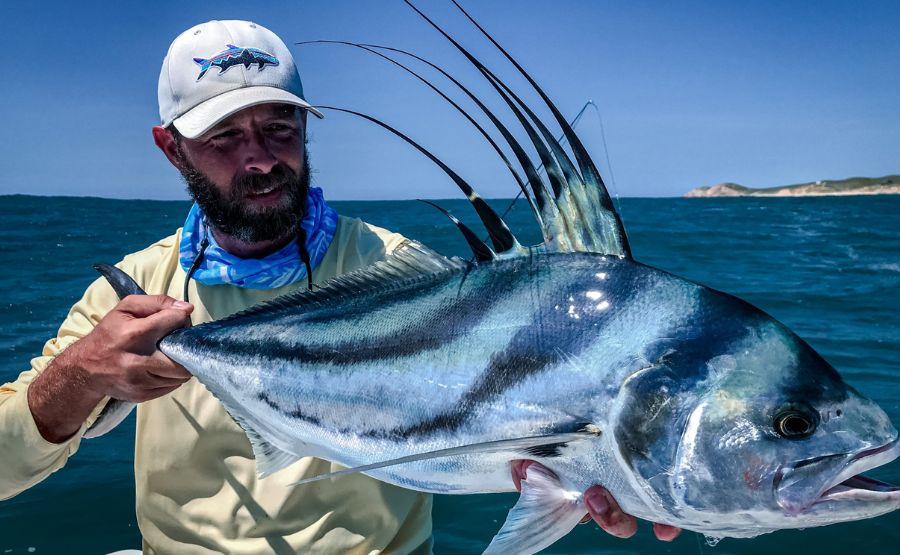

Nobody warned you about this one.
You’re standing on a Pacific beach in Costa Rica or Baja California, watching a boat wake flatten out. Your guide tosses a live mullet near a rocky point. Then the water erupts. A fin cuts the surface like a switchblade opening — seven spines fanned out, locked upright, a dorsal comb that looks like something out of a nature documentary nobody expected to be this dramatic.
That’s a roosterfish. And since before your parents were even born, it has been driving fishermen insane.
Key Facts
| Detail | Info |
| Scientific Name | Nematistius pectoralis |
| Family | Nematistiidae (entirely its own — sole species) |
| Also Known As | Pez Gallo |
| Range | Eastern Pacific — Baja California to Peru |
| Max Length | 163 cm (about 5’4″) |
| Max Weight | 51.7 kg / 114 lbs |
| Average Hooked Weight | ~20 lbs |
| IGFA World Record | 114 lbs — La Paz, Mexico, June 1, 1960 |
| Depth Range | Surface down to ~15–18 meters |
| Conservation Status | Least Concern (IUCN, 2024) |
| Edible? | Technically yes. Worth eating? Virtually nobody thinks so. |
A Creature That Belongs to Nobody’s Club
Here’s something the fishing magazines gloss over. The roosterfish isn’t just unusual — it is literally one of a kind. Every other creature in its family is gone. Nematistiidae has exactly one living member: this fish.
It’s taxonomically isolated. Not close to other jacks, despite looking like one. Not related to billfish, despite fighting like a small one. Researchers think its nearest evolutionary relatives might be moonfish and billfishes, but even that’s a loose association. In the tree of life, this animal is an orphan.
That aloneness shows up in its biology in weird and interesting ways.
See also “The ACFT Score Chart: Everything They Told You Is Already Outdated“
The Ear Thing. Stop Everything.
Most fish articles skip this. Don’t.
The roosterfish has a genuinely strange internal arrangement. Its swim bladder — the gas-filled organ most fish use for buoyancy control — penetrates directly through the skull, threading into the brain cavity and making physical contact with the inner ear. The swim bladder acts as a sound amplifier. The fish essentially hears through its own internal gas bag pressing against its brain.
Many fish can be described as intelligent or adaptable.. But most of them don’t have anatomy that sounds like science fiction. The roosterfish does. And nobody talks about it enough.
What It Actually Looks Like
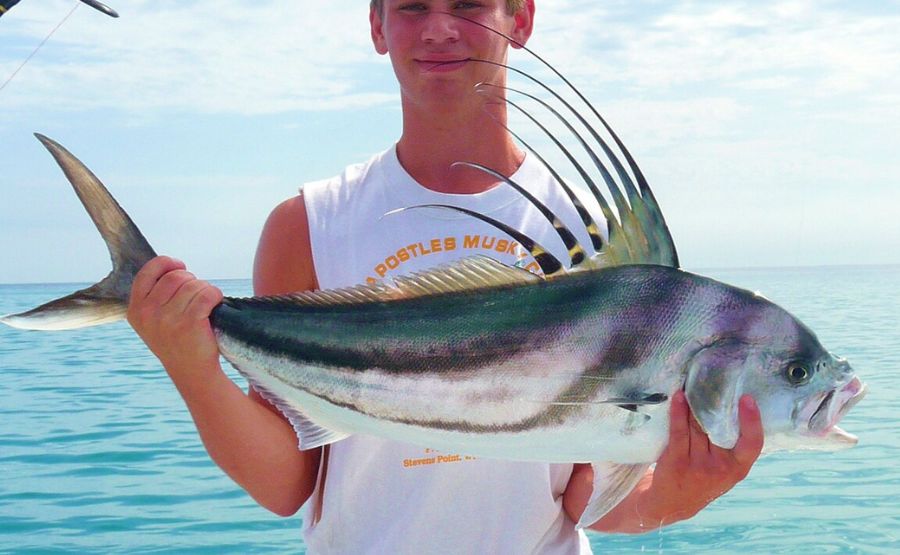
The comb is the thing everyone knows. Seven elongated dorsal spines that raise and flare when the fish gets agitated — chasing bait, getting hooked, patrolling structure. It looks theatrical. Like someone designed a fish for maximum visual impact and then added a punk rock haircut as a finishing touch.
The body itself is muscular and fusiform — built for acceleration, not endurance cruising. Silver-blue flanks with four bold dark bars sweeping down its sides. Long, curved pectoral fins with a dark patch at the base. A tail forked deeply and rigid, built to generate thrust in short, explosive bursts.
Big, dark eyes. A blunt, slightly flattened head full of small, sharp teeth. The whole package reads: fast, mean, visual hunter.
Where It Lives and Why That Matters
Here’s what the roosterfish does NOT do: it does not go offshore. At all.
This is a strictly coastal species. It travels around river mouths, reef edges, rocky headlands, sandy beaches, and surf zones. It is often found a few hundred feet offshore, though occasionally it is in shallow enough water that you may see it cruising from the beach. Maximum depth is roughly 15–18 meters. Most of its time is spent far shallower than that.
Its entire range runs along the eastern Pacific coastline — from the Gulf of California and Baja Peninsula, down through Mexico, Guatemala, El Salvador, Honduras, Nicaragua, Costa Rica, Panama, Ecuador, Peru. Some Galápagos are present too. It doesn’t cross ocean basins. It doesn’t travel to areas without a shoreline to embrace.
This is important for conservation reasons most people don’t think about. An inshore-only species with a limited geographic range is far more vulnerable to localized pressures than a wide-ranging pelagic fish. Overfish one stretch of coast, hammer one population of sardines and anchovies, drop a gillnet across a key beach — and you’ve punched a real hole in the local roosterfish situation. The math doesn’t forgive you just because the IUCN status says “Least Concern” globally.
The Diet: What a Rooster Actually Hunts
Stomach content studies tell an honest story. Anchovies are the number-one item. Then sardines, mullet, blue runners, small bonito, ladyfish, and on occasion squid. Nine species of prey fish and at least one cephalopod identified across sampled roosterfish.
It hunts by driving prey into shallow water and cutting off escape. When you see a roosterfish “herding” baitfish against the surf line, chasing them into inches of water with its comb raised and its body fully committed — that’s a precision ambush, not chaos. The thing about ambush predators is they’re not wasting energy. Every run is calculated.
They follow the bait migrations too. When the sardines move, the roosters move. Which is why fishing quality at a given location swings dramatically depending on what the forage situation looks like that week.
The Fight That Refuses to End
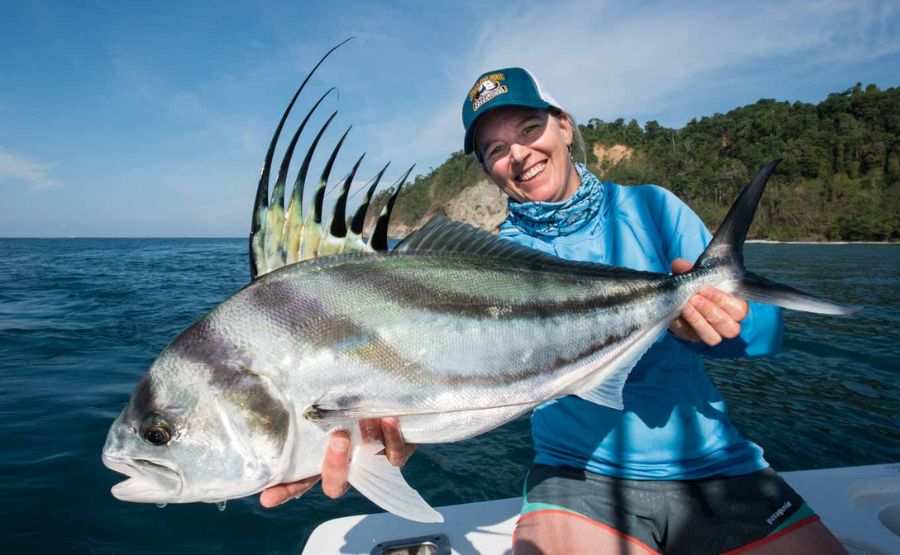
Let’s be completely clear about what happens when you hook one.
The first run is explosive. Head-shaking, direction-changing, surf-crashing chaos. A 25-pound fish on light tackle can take twenty solid minutes to bring to the boat. Some small roosters — under 30 pounds — will actually jump. Larger specimens tend not to jump, but they compensate with brutal sustained endurance. Multiple anglers have written about thinking the fish was almost beaten, only to have it find another gear and make a run that nearly spooled them.
The world record has been held since 1960. Abe Sackheim’s 114-pounder out of La Paz, Mexico — caught on a Penn 250 reel with Ashaway line while trolling. Sixty-six years later, nobody has officially topped it. That’s not because nobody has caught a bigger fish. It’s because the serious sport fishing community has built a culture around releasing these animals rather than killing them for a record.
There’s a documented near-miss that illustrates this perfectly. A fisherman in Las Arenas, Mexico hooked a fish he fought for forty-five minutes on a 40-pound test — a fish that would have smashed that 1960 record into pieces. He released it anyway. His quote afterward was essentially: he was in pain, and he immediately made the questionable decision to throw another bait in the water, hooked a second giant, and then seriously regretted it.
That’s roosterfish culture. You voluntarily hand back the evidence.
The Record That Matters More Than Weight
Here’s the thing about the 114-pound record. It’s not the most interesting roosterfish record out there.
Margaret Shaughnessy holds multiple fly fishing records for this species — including fish over 60 pounds caught on 20-pound tippet. She once fought a roosterfish for over four hours. The fish was so large she couldn’t even see it until three hours into the battle. When her team finally got it aboard, a 60-pound BogaGrip bottomed out against its weight. She released it.
This is the kind of thing that should get more mainstream coverage. Four hours. 60-pound scale maxed out. Released alive.
Eat It? Nobody Does, But They Could
The roosterfish sits in that frustrating space between “technically edible” and “nobody actually wants it.” The flesh is reportedly firm, white, and mildly flavored. But the texture gets described as tough, and the taste gets compared unfavorably to almost every other nearshore species you’d encounter in the same waters.
In practice, across its entire range, virtually every sport-caught roosterfish goes back. Costa Rica has made it mandatory — catch-and-release only, enforced by INCOPESCA. Circle hooks required on all bait. When you land one, the protocol is: keep it in the water, grab a 15-second photo maximum, revive hold, then release.
The commercial fishery for roosterfish essentially doesn’t exist at any meaningful scale. Local artisanal fisheries occasionally land them incidentally, but there’s no industrial market chasing them. This is actually one of the reasons the population is doing better than many coastal predators — nobody wants to eat the thing badly enough to overfish it systematically.
Why the Conservation Story Is More Complicated Than “Least Concern”
The IUCN rated them Least Concern in February 2024. Fine. Globally, the picture isn’t dire.
But zoom in. Bycatch from nearshore gillnets is a real documented threat. Sardine and anchovy overfishing in parts of their range directly cuts into prey availability. Post-release mortality from improper handling is a quiet issue — when you drag a fish out of water, its organs experience pressure changes that can be lethal hours after release if the revival isn’t done right. The tourism pressure from sport fishing is, in most places, better-managed than it used to be, but “better” doesn’t mean solved.
Marine protected areas help where they exist. Tagging programs — particularly out of Costa Rica through FECOP — are building population data that wasn’t available before. The science on roosterfish reproductive biology is still thin. Scientists published age-and-growth studies from otolith analysis as recently as 2021. There’s a lot we still don’t actually know about this animal’s life cycle.
The Destinations: Where to Go If You’re Serious
The Sea of Cortez — particularly around La Paz and Las Arenas — is where the record was set and where serious trophy hunters aim. Multiple fish in the 70–90 pound range get reported out of this area every season. It’s called the roosterfish capital of the world, and history supports that.
Costa Rica’s Pacific coast offers year-round access, with the dry season (December through April) generally producing cleaner water and better action. Quepos, Tamarindo, the Golfo Dulce — all legitimate destinations. The Nicoya Peninsula area has a structure that holds fish consistently.
Panama’s Gulf of Chiriquí produces big fish regularly. Some guides believe potential world-record specimens are sitting in these waters right now, waiting for someone willing to do the work to land one and willing to let it go afterward.
Final Thoughts
The roosterfish doesn’t fit neatly anywhere. It’s not a food fish. It’s not an offshore trophy. It’s not a freshwater species accessible to weekend anglers. It demands travel, coastal access, specific conditions, and real technique to catch.
And somehow, that’s exactly why it matters so much to the people who pursue it.
The 114-pound world record has stood for over six decades not because nobody has caught a bigger fish — but because the culture around this species genuinely pushes back against the kill-and-weigh mentality. That’s rare. That’s actually something worth paying attention to in an era when sport fishing reputation takes constant hits.
The roosterfish is also — and I want to be direct about this — one of the few inshore fish species where you can watch the whole hunt happen. The comb breaks the surface. The bait scatters. The strike is fully visible. You see it start to finish. That’s not something you get with most species that live their drama underwater.
If you ever get the chance to stand on a Pacific beach and watch one of these animals work a bait school in the surf — dorsal fully raised, body committed, water erupting — just take a minute before you do anything else. Because you’re watching a creature that has no close relatives, hears through its own gas bladder, has been fighting humans to a draw for sixty-plus years, and actively refuses to taste good enough to be threatened by its own edibility.
That’s a genuinely remarkable thing to be.
FAQs
1. How big do roosterfish actually get?
The confirmed maximum is 163 cm and about 114 pounds. Average fish that anglers encounter run 20–50 pounds. Anything over 80 pounds is a legitimate trophy. The fish in the 90-plus range exist but are rare.
2. Why is the world record so old?
The 114-pound IGFA record was set in La Paz, Mexico in 1960. It’s still standing because catch-and-release culture dominates this fishery. Bigger fish have definitely been caught since — they just went back in the water.
3. Are roosterfish good to eat?
Technically yes, but practically nobody eats them. The texture is tough, the flavor is considered mediocre compared to nearby species like snapper or dorado, and in many places like Costa Rica, eating them is legally prohibited anyway.
4. Why does the dorsal fin raise up like that?
The seven elongated spines of the dorsal comb raise when the fish is excited — hunting, fighting, or under stress. It’s not fully understood whether this is purely communication, has a hydrodynamic function, or both. The effect is visually dramatic regardless.
5. Where is the best place in the world to catch one?
Las Arenas and La Paz in Baja California for trophy-sized fish. Costa Rica’s Pacific coast for consistent year-round access. Panama’s Gulf of Chiriquí for potential record-class fish. The Sea of Cortez overall has the most historical data supporting trophy catches.
6. How does a roosterfish hunt?
It’s an ambush predator that uses structure, shallow water, and speed to trap bait. It herds prey fish against surf lines and reef edges, cutting off escape routes before striking. The behavior is visible and unmistakable from the surface.
7. Is the roosterfish endangered?
The IUCN assessed it as Least Concern in February 2024. However, localized threats from bycatch, prey depletion, and handling mortality during sport fishing are real ongoing concerns that the “Least Concern” global status can obscure.
8. What’s the best bait for roosterfish?
Live bait dominates — blue runners, mullet, ladyfish, sardines, and small bonito. Surface poppers and stickbaits work well when fish are actively working the surface. Fly fishing for them is possible but extremely difficult.
9. What makes the roosterfish biologically unique?
It is the only surviving member of its whole family. Its swim bladder makes direct contact with its inner ear for enhanced sound detection. It has no close living relatives. It’s genuinely one of a kind among bony fishes.
10. Can you catch one from shore?
Yes, occasionally. Roosterfish come into surf zones and shallow beaches, sometimes within casting distance. Shore-based opportunities are far less reliable than boat fishing, but they happen — particularly in areas with structure very close to the beach.
11. How long do roosterfish live?
Age and growth research from otolith analysis was published as recently as 2021, suggesting the species can live well past a decade. Precise maximum lifespan data is still being built out — the science here is genuinely recent.
12. Why doesn’t anyone talk about the roosterfish’s hearing?
Honestly? No idea. The swim bladder-to-inner-ear anatomy is one of the stranger biological arrangements in coastal fish, and it barely appears in popular articles about the species.It receives significantly less attention than it merits.
Keep discovering, connecting, and thriving with The Nexus Magazine every day.