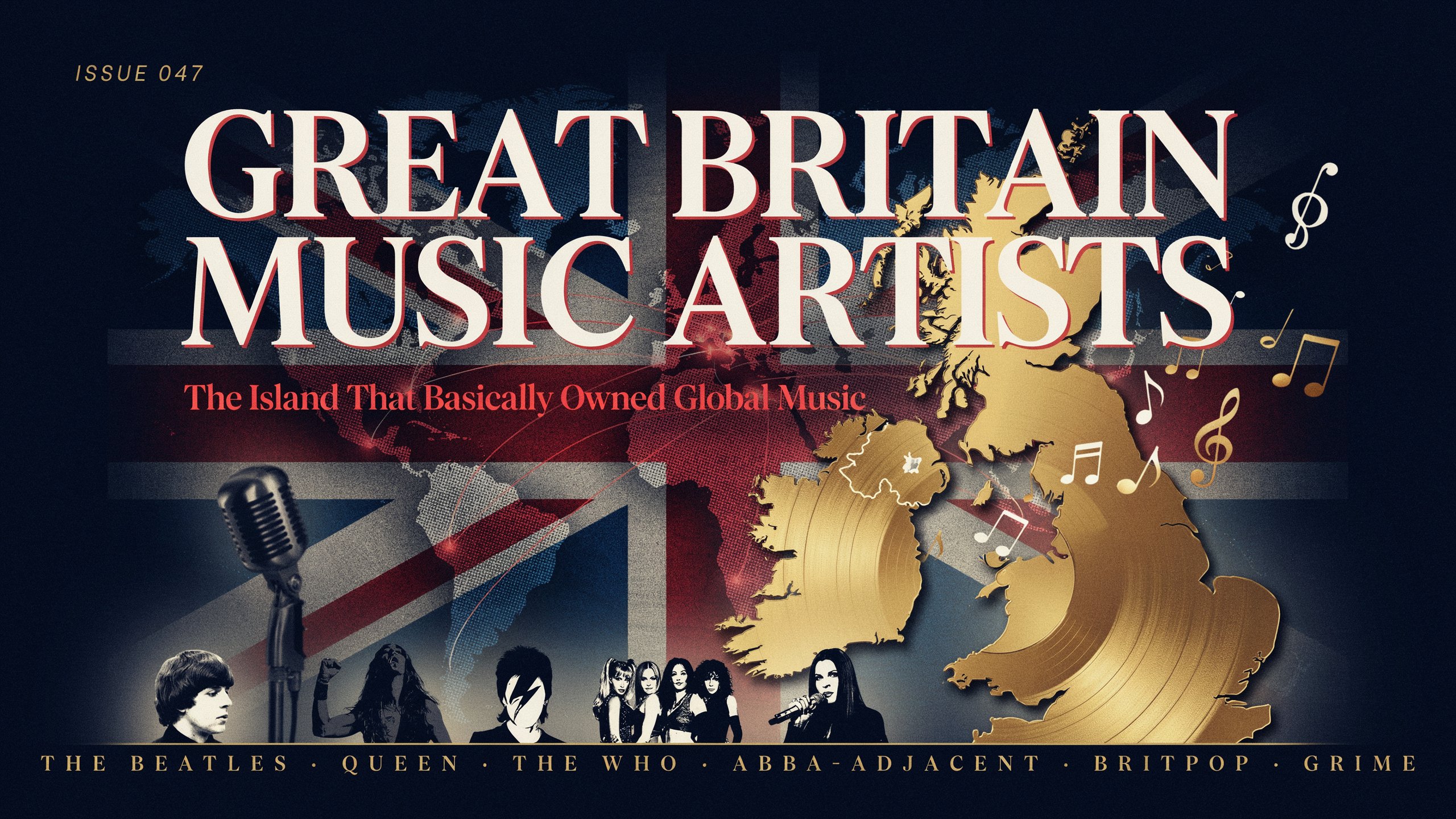

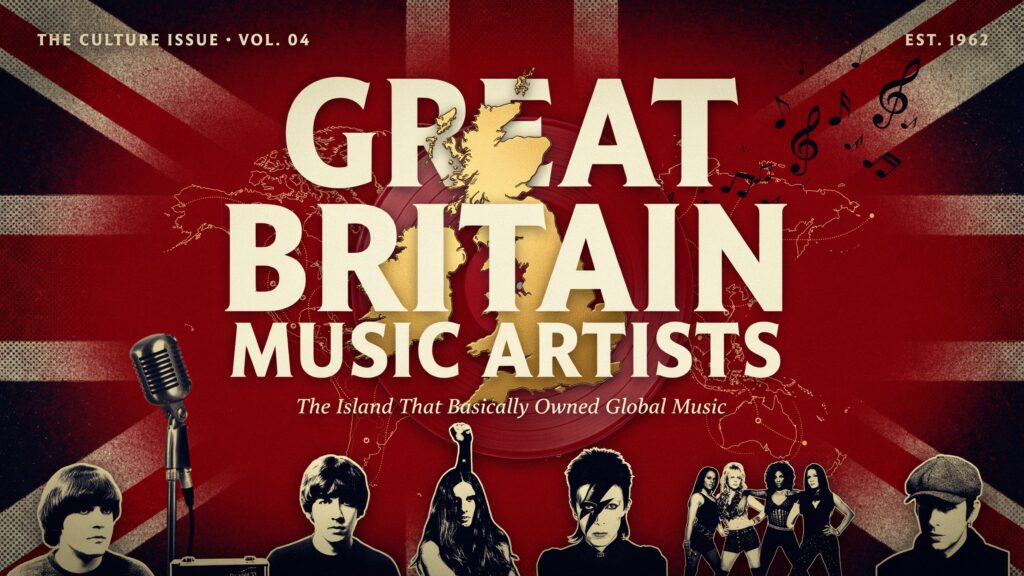
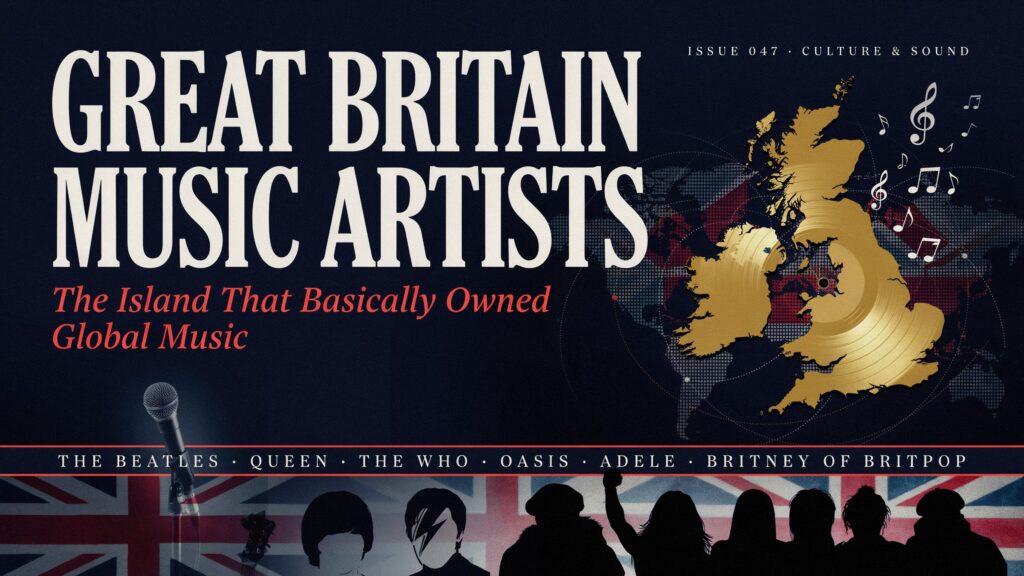
Let me say something that might annoy you. Britain is a tiny island. Smaller than the state of California. And yet it somehow produced the Beatles, the Rolling Stones, David Bowie, Freddie Mercury, Amy Winehouse, Adele, and Ed Sheeran. All from the same patch of grey, rain-soaked land. That’s not a coincidence. That’s something genuinely weird and worth talking about.
Quick Reference
| Artist | Born | Genre | Era | Notable Achievement |
| The Beatles | 1960–1970 | Rock/Pop | 1960s | Best-selling band in history |
| Rolling Stones | 1962–present | Rock/Blues | 1960s–2020s | 8 US #1 hits; still touring |
| David Bowie | 1947–2016 | Glam/Art Rock | 1969–2016 | “Chameleon of Rock”; 26 studio albums |
| Freddie Mercury | 1946–1991 | Rock/Opera | 1970–1991 | 4-octave range; Rock Hall of Fame 2001 |
| Elton John | 1947–present | Pop/Rock | 1970s–present | Farewell Tour grossed $900M+ |
| Amy Winehouse | 1983–2011 | Soul/Jazz/R&B | 2003–2011 | 5 Grammys in one night (2008) |
| Adele | 1988–present | Pop/Soul | 2008–present | 150M+ records sold; 15 Grammys |
| Ed Sheeran | 1991–present | Pop/Folk | 2011–present | 14 UK #1 singles; biggest artist of the 2010s |
| Dua Lipa | 1995–present | Pop/Disco | 2017–present | UK’s most-played artist of 2020 |
It Started With Theft, Actually
This is what no one wants to say aloud. The British Invasion of the 1960s — that moment where Britain essentially took over American music — was built on American raw material. Young British musicians grew up listening to American rock and roll and soaked in the sounds of artists like Elvis, Chuck Berry, and Buddy Holly. Then they rebuilt those sounds, gave them a British edge, and sold them back to America at full price.
And America loved every second.
The Beatles, Rolling Stones, Gerry and the Pacemakers, The Who, The Kinks — they all came flooding across the Atlantic and topped US charts simultaneously. American artists didn’t know what hit them. Elvis himself couldn’t get a decent hit during that period. In ’64, it was all over for American singers. An entire generation of homegrown pop talent got wiped off the map.
Brutal? Sure. But also kind of impressive.
See also “Can You See Who Views Your Reels on Instagram? The Full, Unfiltered Truth“
The Beatles: The Band That Changed Everything
Let’s get this out of the way fast. The Beatles are officially the best-selling band in history. That’s the baseline. Everything else is commentary.
Their October 1963 performance at the London Palladium made them famous across Britain and ignited Beatlemania at home — a show broadcast live to twelve million viewers. Then they crossed the Atlantic and everything exploded. Over 73 million people tuned in to watch their Ed Sullivan debut in February 1964. That number is almost incomprehensible by today’s standards. We’re talking about a country glued to a single television moment.
What made them different? John Lennon didn’t write soft pop. Neither did McCartney, not really. They pushed boundaries constantly. By 1967, albums like Sgt. Pepper’s Lonely Hearts Club Band were bringing in orchestras, strange production effects, and deeper lyrics — changing how the entire world thought about what an album could be.
Four guys from Liverpool. Nobody saw them coming.
David Bowie: Genius, Chameleon, Deeply Complicated Human Being
Okay. Let’s talk about Bowie. Because you can’t write about British music without him, and you also can’t pretend his story is simple.
The genius part first. David Robert Jones — born January 8, 1947 — spent over five decades reinventing himself musically and visually, and is often called the “chameleon of rock.” That’s not a cliché. He genuinely meant it. Ziggy Stardust. Aladdin Sane. The Thin White Duke. Each persona was a full creative pivot, not just a new outfit. His 1969 single “Space Oddity” was his first real chart hit, timed deliberately alongside the Apollo 11 launch.
Now the complicated part. And I’m not going to skip it just because Bowie is an icon.
During his cocaine-driven era in the mid-1970s, Bowie adopted the persona of the Thin White Duke and made genuinely inflammatory public statements — including calling Adolf Hitler one of the first rock stars and suggesting Britain might benefit from fascist leadership. He was seen making what many perceived to be a Nazi salute while driving an open Mercedes outside Victoria Station. Bowie later claimed it was a wave caught at the wrong moment.
He spent much of the 1980s and ’90s walking those comments back. And then there are the allegations surrounding underage girls in the early 1970s — allegations that have never gone to court but have never fully gone away either. It is now a matter of record that he was in sexual relationships with Lori Maddox and Sable Starr when they were 13 and 15 respectively.
You can love the music and still hold the person accountable. Both things are true at once.
Freddie Mercury: Arguably the Greatest Live Performer Who Ever Lived
Bold claim. I’ll stand by it.
Freddie Mercury — born Farrokh Bulsara — co-founded Queen in 1970 and possessed a four-octave vocal range that set him apart from virtually every other rock singer alive. The technical ability was extraordinary. But technique alone doesn’t explain why people still talk about him the way they do.
The answer is Live Aid, July 13, 1985. In front of an estimated global TV audience of 400 million people and a sold-out Wembley crowd of 72,000, Queen performed and was widely described as the highlight of the entire concert. Bob Geldof, who organized the event, said they simply “smashed one hit after another.” An industry poll in 2005 ranked it the greatest rock performance of all time.
Think about that. Decades later, with incredible competition, still number one.
Mercury died in 1991 from AIDS-related complications. He had confirmed his diagnosis just one day before his death. The music world stopped.
The Rolling Stones and Keith Richards: The Indestructible Rock Disaster
The Rolling Stones are the band that should not still exist. And yet here they are.
Keith Richards specifically should not still be alive. He has been tried on drug-related charges five times: in 1967, twice in 1973, in 1977, and in 1978. The 1977 Toronto arrest is legendary — police found heroin in his hotel room and charged him with possession for the purpose of trafficking, an offence carrying a potential sentence of seven years to life. He avoided prison thanks partly to a blind fan who testified on his behalf, and was ordered to play a benefit concert for Canada’s National Institute for the Blind instead.
That’s rock and roll justice.
The rumor that Richards survived heroin addiction by having his blood entirely replaced in Switzerland? Urban myth. Richards himself started the story as a joke when journalists wouldn’t stop asking him how he cleaned up. He enjoyed the legend too much to correct it for years.
Meanwhile, the Rolling Stones topped the US Hot 100 eight times and are still touring into their eighties. The music world can’t quit them.
Amy Winehouse: The Voice That Made Everyone Stop and Listen
She released two albums. Just two. And people still talk about her the way they talk about artists who put out twenty.
Back to Black, released in October 2006, transformed Winehouse from a promising British talent into a global phenomenon. The blend was unusual — jazz foundations, 1960s girl group aesthetics, contemporary R&B production, and a voice that sounded like it had lived three hard lifetimes. She won multiple Grammy Awards at the 2008 ceremony, one of those rare nights where talent was undeniable even to people who didn’t know her name before.
Her personal struggles were public. Too public. The press treated her addiction like entertainment. That part is genuinely uncomfortable to look back on.
She died in 2011, aged 27. Her impact on British music created a direct lineage — Adele has openly credited Winehouse, saying “Because of her, I picked up a guitar, and because of her, I write my own songs.”
One artist directly building another. That’s a legacy with teeth.
Adele: The Power of Just Singing Well
In an era of choreography, auto-tune, and spectacle, Adele walked out and just… sang. That was the whole move. And it worked so massively it broke records that had stood for decades.
Her album 21 topped the US Billboard 200 for 24 consecutive weeks — the best-performing album in US chart history for that stretch. She has sold over 150 million records worldwide and collected 15 Grammy Awards and 12 Brit Awards.
She’s from Tottenham, North London. She went to the BRIT School. She sounds like a person, not a product. In an industry obsessed with manufacturing perfection, that realness landed like a bomb.
The New Wave: Ed Sheeran, Dua Lipa, Harry Styles
Britain never really stopped producing. It just kept changing shape.
Ed Sheeran became the biggest artist of the 2010s according to the Official Charts Company, amassing 14 UK number one singles and eight number one albums. The man doesn’t stop working. His hits have spent 323 weeks — that’s six years combined — in the UK Top 10 since 2011. That’s not luck. That’s genuinely relentless output.
Then Dua Lipa arrived and reminded everyone that disco never really died. Her album Future Nostalgia moved 265,042 copies in the UK alone in 2020 — during a global pandemic when nobody was going outside. People were locked down and still buying Dua Lipa albums. That says something.
In 2017, British music export revenues hit a record high of £2.6 billion — with Sheeran, Styles, Dua Lipa and Sam Smith all appearing in the global Top 10. Eight of the UK’s top ten albums that year came from British artists. Britain wasn’t declining. It was accelerating.
Why Does Britain Keep Doing This?
Genuinely — why? What is it about this island?
African, South Asian, Caribbean, and other musical traditions were brought together by a populace with a wide range of ethnic backgrounds. That’s part of it. Britain’s art school culture gave musicians like Lennon, Bowie, Mercury and Pete Townshend space to think outside commercial formulas. The pub scene, the small venues, the regional sounds — Liverpool’s Merseybeat, London’s blues scene — all feeding each other.
And maybe some of it is just stubbornness. British musicians don’t wait to be invited. They show up and take space.
Final Thoughts
Here’s my honest take. We have a tendency to flatten these people into legends. Smooth out the edges. Make them safe and inspirational.
The reality is messier. Bowie was a genius who also did inexcusable things. Richards was a brilliant musician who was also a walking chemistry experiment. Mercury never got to live openly as who he was during most of his career because the world wouldn’t let him. Amy Winehouse was eaten alive by public attention at her most vulnerable. These aren’t feel-good stories dressed up as biographies.
But the music? The music was real. Britain produced a volume and quality of musical output across six decades that no other country of its size has matched. That matters. It just doesn’t erase the complicated human beings behind it.
Great Britain’s music legacy is extraordinary. And honestly, still being written.
FAQs
1. Who is the best-selling British music artist of all time?
The Beatles hold that title — officially the best-selling band in history, with more UK number one albums than any other act.
2. What exactly was the British Invasion?
A cultural phenomenon of the mid-1960s where British rock and pop acts became hugely popular in the United States, fundamentally reshaping American music and opening the door for British artists to achieve international success ever since.
3. Was Freddie Mercury actually British?
Born Farrokh Bulsara in Zanzibar (now Tanzania), he grew up partly in India and moved to Britain as a teenager. He holds British nationality and is claimed — rightly — as a British icon.
4. Why did the British Invasion succeed so quickly?
American audiences were genuinely bored. US teenagers were growing tired of the singles-oriented pop acts of the late 1950s and early 1960s. The British acts brought energy, originality, and a sound that felt completely new.
5. How many records has Adele sold worldwide?
Over 150 million records globally as of recent reporting. She remains one of the highest-selling solo artists in history.
6. Did David Bowie really have fascist beliefs?
He made deeply inflammatory pro-fascist statements during his “Thin White Duke” era, which he later attributed to severe cocaine addiction during what he described as the darkest years of his life. He spent years publicly apologizing and eventually became a vocal advocate for multiculturalism.
7. Why is Amy Winehouse still so influential even though she only released two albums?
Because the quality was extraordinary. Back to Black specifically created a template for British soul and R&B that artists like Adele, Sam Smith, and an entire generation of British singers followed directly. Two albums can be enough.
8. Is Ed Sheeran genuinely the biggest British artist of modern times by numbers?
The Official Charts Company crowned him the biggest artist of the 2010s, so yes, by pure chart performance, the argument holds up.
9. What did Keith Richards actually do to get arrested in Canada in 1977?
Police found heroin in his Toronto hotel room and charged him with possession for the purpose of trafficking, a charge carrying seven years in prison. He ultimately avoided jail time.
10. Did Britain’s music industry grow or shrink in the streaming era?
Grew — dramatically. British music export revenues hit a record £2.6 billion in 2017, with the UK music industry contributing £4.5 billion total to the UK economy that year.
11. Who was the most-played artist in the UK in 2020?
Dua Lipa, driven by her album Future Nostalgia — unseating Ed Sheeran who had held that position every year since 2017.
12. Is British music still relevant today or is it past its peak?
Look at the charts. Dua Lipa, Harry Styles, Olivia Dean, Sam Smith, Charli XCX — all British or British-trained. The pipeline hasn’t dried up. The island keeps producing.The only truly unanswered question is whether the next wave will produce legends in the same manner as the 1960s and 1990s did.
Keep discovering, connecting, and thriving with The Nexus Magazine every day.