
Key Facts
| The Number | 25 centimeters |
| In inches | ~9.84 inches (practically 10) |
| In meters | 0.25 meters — exactly one quarter |
| Body reference | Average adult forearm, elbow to wrist |
| Ancient parallel | Close to the original Roman/Greek span measurement |
| Where it keeps showing up | Keyboards, chef’s knives, school rulers, tablet screens, water bottles, A4 paper width |
| Why it matters | It’s the sweet spot between “too small to matter” and “too big to be convenient” |
| The bigger story | A measurement born from revolution, resisted by one stubborn nation, and embedded in almost everything you own |
You’re looking at this screen right now. The device in your hand — or on your desk — almost certainly has something measuring 25 centimeters on it. Perhaps it’s the keyboard’s width. Maybe it’s the screen diagonal. Maybe it’s the entire device height. And you’ve probably never once stopped to notice.
That’s the thing about 25cm. It’s hiding in plain sight.
See also “Trace Walkthrough: The Most Underrated Debugging Skill Nobody Talks About Enough“
A Meaningless Number Until It Becomes Everything
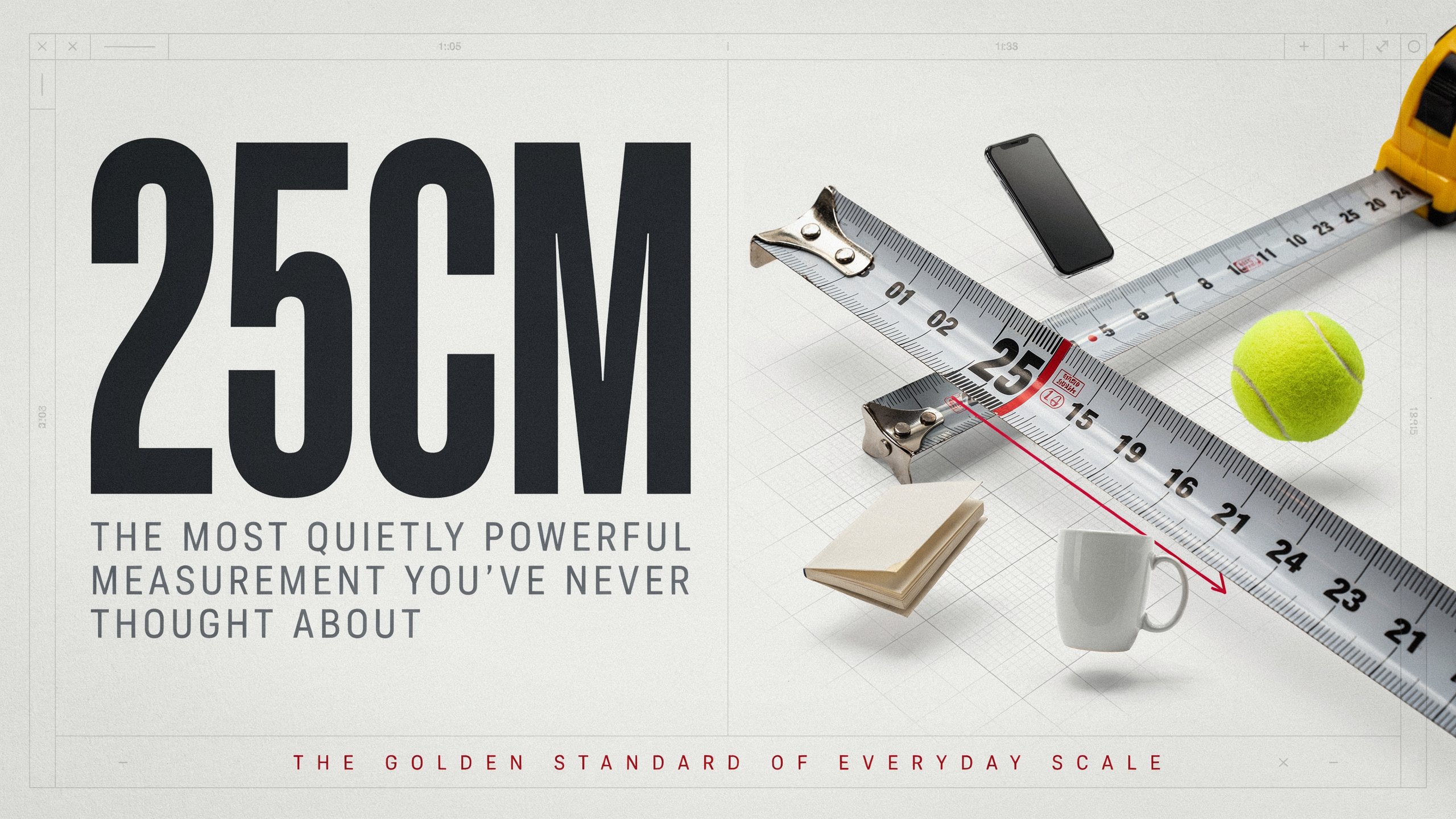
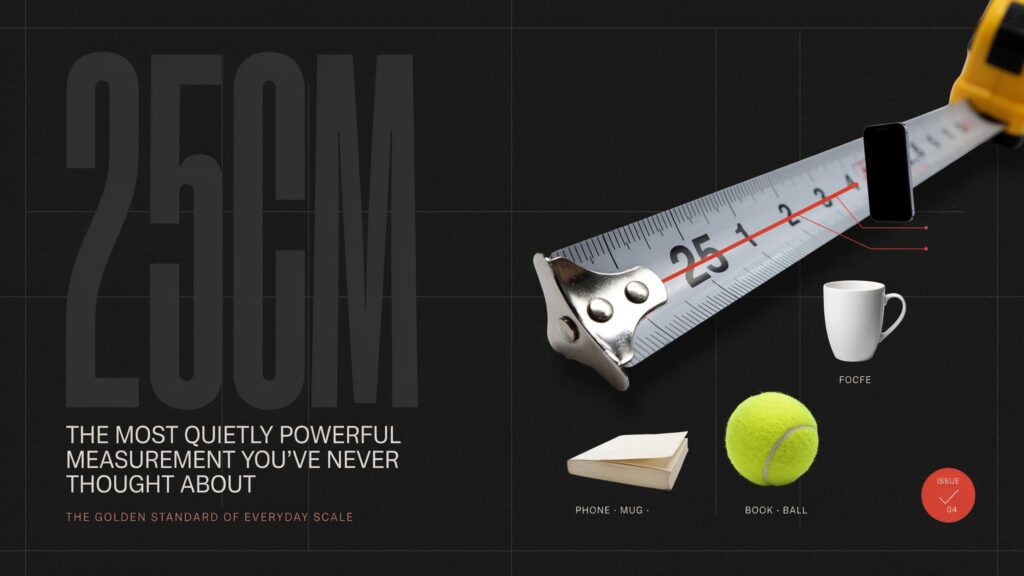
Pull out a chef’s knife. Blade length: usually 20 to 25cm. Grab your tablet. Screen height: often right around 25cm. Stretch from the elbow to the wrist. Average adult forearm: 25cm. It’s almost eerie.
But here’s what gets really interesting. This measurement isn’t arbitrary. There’s history packed into it. Ancient history, revolutionary history, and even a long-running geopolitical argument that’s still not settled — all wrapped up in a number that most people never bother thinking about.
So let’s think about it.
Wait — How Did We Even Get Centimeters?
This part matters more than people realize. The centimeter didn’t just appear. Someone invented it. And the circumstances of that invention are genuinely wild.
France, 1789. Revolution. Chaos. Guillotines. But also — weirdly — a push for rational measurement. Before the metric system existed, France had around 400 different ways to measure land area alone. Think about that for a second. Four hundred. One unit in Paris meant something completely different in Lyon. Merchants couldn’t trust each other. Trade was a mess.
The French National Assembly said: enough. They commissioned the Paris Academy of Sciences to build something new. Something logical. Something that was scaled by powers of ten and derived from nature itself, not from the length of some king’s foot.
The scientists landed on a beautiful idea: one meter would equal one ten-millionth of the distance from the North Pole to the Equator as measured from Paris. From that meter, everything else derived. Centimeters. Milliliters. Kilograms. All connected. All rational.
In 1795, France formally adopted the metric system. The first platinum meter standard was locked in the national archives in 1799. And 25 centimeters — one quarter of that hard-won, mathematically derived meter — became a slice of that revolutionary logic.
Napoleon, incidentally, hated it. He reportedly called the whole project “tormenting the people with trivia” and briefly banned metric. The man conquered most of Europe and still couldn’t win against a unit of measurement. Make of that what you will.
The Body Knew First
Here’s the beautiful part that gets buried under all the historical drama. The metric system was supposed to be based on nature, not on human bodies. But 25 centimeters is stubbornly, almost poetically, human.
The forearm — from elbow to wrist — averages about 25cm for adults. Ancient Greek and Roman measurements used something called a cubit, which was roughly the forearm length. Egyptian royal cubits were a bit longer (around 52cm), but the span measurement — the distance across an outstretched hand — ran 20 to 25cm.
Humans were measuring in roughly-25cm chunks thousands of years before the French Revolution put it in a laboratory.
There’s something satisfying about that. All those scientists arguing over platinum bars and meridians, trying to divorce measurement from the human body — and the human body just kept showing up at the same answer. 25cm is a human-scale number. It fits in your hand. It fits your reach. It fits your life.
The American Problem (Yes, This Is Relevant)
There are precisely three nations on Earth that do not use the metric system as their standard, including the United States. Liberia and Myanmar are the other two. Yes, that is the full list.
This matters to the 25cm conversation because it creates this strange split-brain world. Ask an American how big something is and they’ll tell you inches. Ask their doctor how much medication they’re taking and they’ll tell you milligrams. The football field is in yards. The engine displacement is in liters. The packaging has both labels and everyone quietly ignores one of them.
How did this happen? The quick version: when the metric system was being born in France in the 1790s, America was also being born as a country. Thomas Jefferson was actually in communication with French scientists about it. He was genuinely interested. But Congress dragged its feet. Then America entered into a treaty with Britain that France considered a betrayal, and France disinvited the US from the metric planning conference in 1798.
The US consequently never got standardized into the metric world at the founding moment. By the time it could have switched, the industrial infrastructure was already locked into inches and feet. Changing road signs, factory tooling, school curricula — the cost was enormous. Inertia won.
One history professor described American opposition to the metric system as the belief that adopting it was “a dangerous invitation to sow the seeds of revolution.” Which, given that the metric system literally came out of a revolution, is not entirely wrong logic. Just wrong priorities.
Metric has been legal in America since 1866. It’s been the “preferred” system for trade and commerce officially since 1975. And still, most Americans will give you a blank look if you tell them something is 25cm long.
So What Actually IS 25cm?
Let’s get concrete, because abstract history only goes so far.
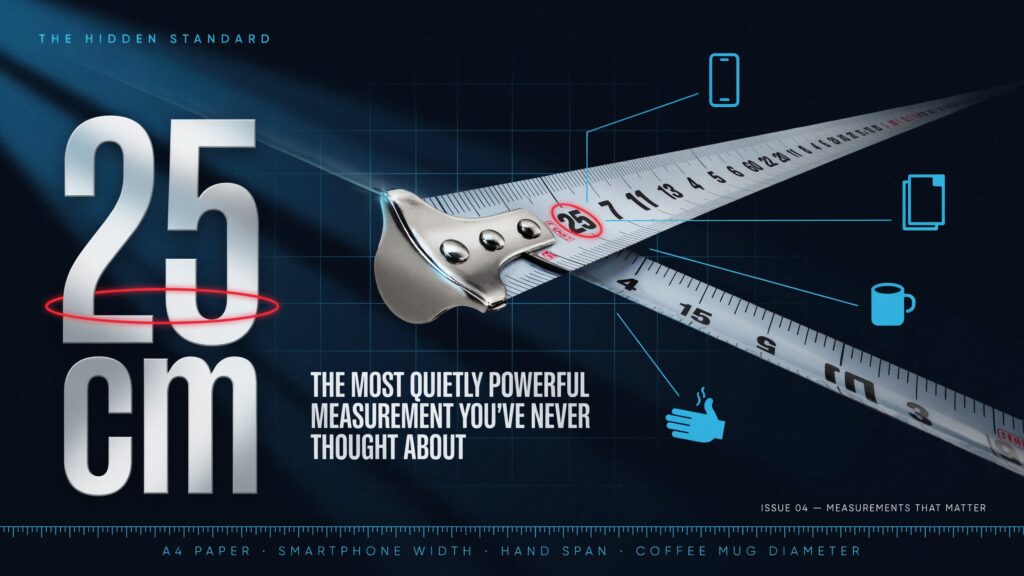
25cm is the width of the shorter side of A4 paper — the standard paper size used by almost every country except the United States. It’s the height of a typical water bottle or sports bottle. It’s the blade length on a good utility chef’s knife. It’s what a standard laptop keyboard measures across. Mini tablet screens hit close to this. A hardcover book standing on edge often reaches just this height.
There’s a reason all these things converge around this dimension. 25cm lives right in what ergonomists call the “comfortable grip and control” zone for most adults. It’s big enough to be useful but small enough not to feel unwieldy. Designers didn’t plan for everything to be 25cm — it just keeps being selected for that length because it works.
And here’s the freaky body measurement thing again: your forearm from elbow to wrist is your personal 25cm ruler. Carry it everywhere. Use it. The ancient Romans figured this out and so can you.
25cm in the Real World of Making Things
Fashion designers work in centimeters constantly. Tech packs — the specification documents that factories use to actually manufacture clothes — are full of centimeter measurements. Garment spec sheets list every measurement point: sleeve length, hem drop, collar width. When a woman’s long wallet needs to fit a phone and still close properly, someone made a deliberate decision that 25cm was the right call.
Clutch bags cluster around this dimension. Belt lengths reference it for notch placement. Necklaces with a 25cm drop sit mid-chest — a specific aesthetic choice that every jewelry designer knows.
This is what standardized measurement actually gives you. Not just the ability to say “this thing is 25cm.” The ability to say it the same way in 195 countries, communicate across languages and factories and suppliers, and have the thing actually come out the right size when it arrives in a warehouse six thousand miles from where it was designed.
That’s not romantic. But it’s real.
The Medical Precision You Never Think About
Here’s a 25cm fact that has nothing to do with kitchen knives.
There’s an endoprosthesis device — the GORE VIABAHN — specifically designed in a 25cm length for treating blocked arteries in the upper leg. Clinical trials. FDA oversight. Precise 25cm specification. Because in vascular medicine, the length of the blocked segment in the superficial femoral artery commonly falls around that range, and treating it requires a device matched to anatomy.
25cm shows up in blood pressure cuff bladder designs. In anatomy research defining what “standard” forearm length means across populations for forensic identification. In rehabilitation equipment. In the measurements that determine whether a medical device fits the body it’s supposed to be inside.
This isn’t abstract. This is the number that can determine whether a medical procedure works.
The Metric Holdout Culture (A Small Rant)
Here’s where I’m going to say something controversial: the continued American resistance to metric is one of the most expensive acts of cultural stubbornness in modern history.
It’s not just inconvenient. It costs actual money. Engineers working with international partners do double conversions. Products need dual labeling. A NASA Mars orbiter crashed in 1999 — a $125 million spacecraft — because one engineering team used metric units and another used imperial units in the same calculation. Nobody caught it. The thing burned up in the Martian atmosphere.
Sometimes, “we’re used to inches” really does cost that much.
25cm shouldn’t need translation. In most of the world, it doesn’t. You say 25 centimeters and everyone immediately knows what you mean, can visualize it, can build to it. In the US, you convert to “about 9.84 inches” or “just under 10 inches” and then someone asks “is that more like a foot-long sub or more like a dollar bill?” and suddenly you’re doing improvisational measurement charades.
The rest of the world solved this. The answer was called the metric system and it came out of a revolution in 1789.
The Elegance of a Quarter
One reason 25cm specifically feels so satisfying is pure math.
25cm is exactly one quarter of a meter. That’s 0.25. Clean. Simple. No messy remainders, no endless decimal digits. The metric system’s genius — the thing the French revolutionaries built into it deliberately — is that everything divides evenly. You go from meters to centimeters by multiplying by 100. You get to 25 by halving twice.
Compare that to the imperial equivalent. 25cm is approximately 9.84252 inches. That number is approximately never finished. It just keeps going. There’s no natural resting point in it.
The metric system was designed by mathematicians who cared about elegance. 25 is an elegant metric number. It’s two and a half decimeters. It’s a hundred and a half millimeters past a typical hand span. Everything about it divides cleanly.
This is why scientists everywhere use metric even when their home culture resists it. Elegance in numbers isn’t just aesthetic. It reduces errors. It simplifies communication. Because the math is shorter, there is a lower chance of an error.
What the Future Looks Like at 25cm
Screens keep changing. Device sizes shift with every generation of hardware. And yet 25cm keeps showing up in the screen-size conversations — it’s where “small tablet” starts and where “large phone” ends.
As more of daily life compresses into devices, the ergonomics of what fits in a hand and what fits in a bag matter more, not less. And the hand hasn’t changed. The forearm hasn’t changed. 25cm remains the natural sizing attractor for things meant to be held, carried, and used.
Wearable tech designers are learning what knife makers and leather goods designers already knew: human bodies are the most stubborn constants in product design. And the average human elbow-to-wrist length is approximately 25 centimeters.
This isn’t going anywhere.
Final Words
The people who spend their days thinking about this stuff — engineers, designers, ergonomists, surgeons — all work in centimeters. The people who don’t think about it at all — most of the general public in one particular country — miss something fundamental about precision and shared language.
25cm is not just a measurement. It’s a small piece of evidence that when humans decide to build rational systems instead of inheriting chaotic ones, things actually get better. More communicable. More accurate. Less prone to catastrophic errors.
The metric system was born from the idea that measurement should serve everyone, not just the people who happen to live near a particular king’s foot. One of the most straightforward ways to represent that idea is 25 centimeters.
You carry a 25cm ruler on your body already. Your forearm. Use it. And maybe, just maybe, stop converting to inches.
FAQs
1. How long is 25cm in inches exactly?
25 centimeters equals approximately 9.843 inches. For practical purposes, most people round to “just under 10 inches.” The decimal doesn’t end neatly, which is kind of the whole argument for metric in miniature.
2. What everyday object is closest to exactly 25cm?
The standard 25cm school ruler is literally defined at this length. Your adult forearm from elbow to wrist is another excellent living reference. The width of an A4 page’s short side (actually 21cm) is slightly under, while the keyboard of most laptops lands very close at ~25cm across.
3. Is 25cm a “standard” measurement in manufacturing?
It appears frequently in product specs — fashion accessories, kitchen tools, tablet screens, medical devices — but it’s not a formally mandated standard dimension. It keeps recurring because it aligns with human ergonomics rather than because a committee decided it should.
4. Why did the French Revolution lead to the metric system?
Before the revolution, France had hundreds of incompatible local measurement systems. Trade was chaotic. The revolutionary government wanted to unify the country under rational, universal standards. The meter was defined as a fraction of Earth’s circumference, making it independent of any ruler or region. Centimeters followed as one-hundredth of a meter.
5. Why does the US still use inches instead of centimeters?
A combination of early political timing (the US standardized before metric was fully established), industrial lock-in, voluntary rather than mandatory adoption policies, and cultural resistance. The metric system has been legal in the US since 1866 but never required. Inertia and cost of conversion have kept imperial units dominant in daily life.
6. Is the forearm really 25cm for most adults?
Reasonably close. Research puts the average forearm length (elbow to wrist) at around 25cm for many adult populations, though there’s variation by sex, ethnicity, and individual body type. It’s a useful rough estimate, not a medical absolute.
7. What medical devices use a 25cm specification?
Vascular endoprostheses — devices implanted in arteries — are manufactured in specific lengths including 25cm to match common lesion lengths in arteries like the superficial femoral artery. Blood pressure cuff bladder dimensions also reference specific centimeter measurements for accuracy.
8. How does 25cm show up in fashion design?
Clutch bags, long wallets, necklace drop lengths, belt measurement references, and sleeve specifications frequently land around 25cm. Fashion tech packs — the manufacturing blueprints used by factories — specify measurements in centimeters, and 25cm appears across multiple garment categories as a recurring usable dimension.
9. Is Napoleon really why metric was almost abandoned?
He did briefly reinstate traditional French units via a compromise called mesures usuelles, redefining old units in rounded metric amounts. But after his fall, the conservative pushback faded. France officially and exclusively adopted the decimal metric by law in 1837 — about 42 years after it was first introduced.
10. Why is 25cm considered a “sweet spot” in product design?
It sits in the zone where objects feel graspable and manageable for most adult hands but are still large enough to be functionally useful. Products in this size range tend to be portable, storable, and comfortable to operate. It’s not a designed-in standard — it’s a repeatedly selected-for outcome driven by human anatomy.
11. What’s the connection between 25cm and A4 paper?
A4 paper measures 21 x 29.7cm. The short side (21cm) is slightly under 25cm, and the long side (29.7cm) is a bit over. So A4 paper brackets are 25cm — it’s between the two dimensions, which makes the paper a useful rough mental reference even if it doesn’t hit the number exactly.
12. Will the US eventually go fully metric?
Probably not anytime soon in everyday life. Scientific, medical, and technical industries already use metric. Consumer life remains mostly imperial. The political will to force a complete switch has evaporated every time it’s been attempted. What’s more likely is continued coexistence — the chaotic, illogical, very American coexistence of two systems nobody fully commits to.
Keep discovering, connecting, and thriving with The Nexus Magazine every day.